 viuww.com
Aug 30, 2026
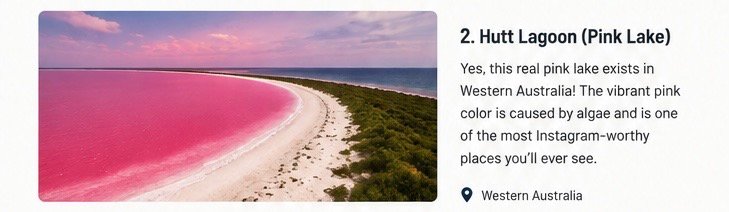
Hutt Lagoon — The Pink Lake That Looks Like Another Planet
Located near Port Gregory in Western Australia, Hutt Lagoon is one of those places that can make you question whether you’re still on Earth.
Depending on the season, weather and time of day, the water can appear bright pink, purple or even deep red. The incredible colour is created by natural microorganisms and algae that thrive in the salty water.
From above, the contrast between the pink lake, white salt edges and surrounding landscape looks almost surreal.
The best part? You don’t need to travel to another country to see it. This extraordinary landscape is right here in Australia.
If you’re driving along the Coral Coast, it’s definitely worth stopping for a closer look — and of course, a few unforgettable photos.
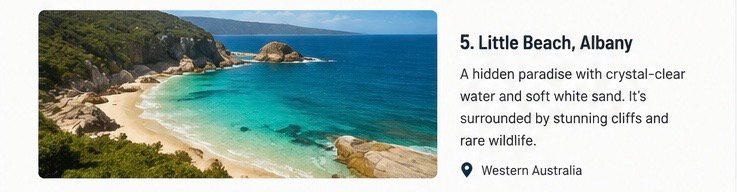
2. Little Beach, Albany — A Hidden Slice of Paradise
Western Australia is home to some of the world’s most beautiful beaches, but Little Beach near Albany feels particularly special.
The water is incredibly clear, shifting between shades of turquoise and deep blue. Soft white sand stretches along the shoreline, surrounded by massive granite rocks and natural bushland.
On a calm day, the water can look almost like a tropical island somewhere in the Pacific.
Despite its beauty, Little Beach often feels quieter than Australia’s more famous beaches. It’s the kind of place where you can sit back, listen to the waves and forget about everything else for a while.
If paradise had an Australian version, this might be it.
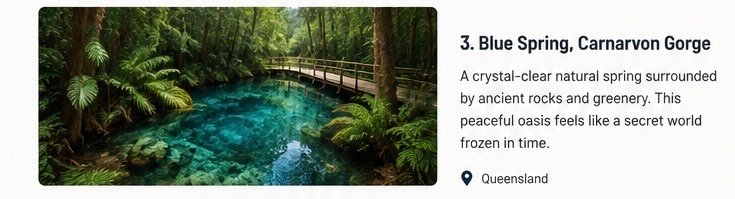
3. Carnarvon Gorge — A World Hidden Inside Queensland
Deep inside Queensland lies Carnarvon Gorge, a place filled with towering sandstone cliffs, ancient landscapes and hidden natural pools.
Walking through the gorge feels completely different from the typical Australian landscape many people imagine.
Tall cliffs rise on both sides of the valley, while walking trails lead visitors through narrow passages, forests and areas filled with native wildlife.
Some parts of the gorge contain ancient Aboriginal rock art, reminding visitors that this landscape has a history stretching back thousands of years.
The further you explore, the more the environment seems to change.
One moment you’re walking through open bushland. The next, you’re surrounded by towering cliffs and lush greenery.
It’s a reminder that Australia is far more diverse than most people realise.
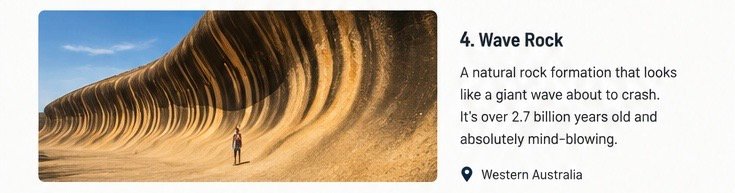
4. Wave Rock — Nature’s Giant Frozen Wave
At first glance, Wave Rock looks exactly like its name suggests — a massive ocean wave frozen in stone.
Located near Hyden in Western Australia, this incredible rock formation rises around 15 metres high and stretches for more than 100 metres.
The curved shape was created naturally over millions of years through erosion and weathering.
Standing next to it gives you a completely different perspective on its size.
The rock’s unusual shape, combined with its natural colours and patterns, makes it one of Australia’s most fascinating geological landmarks.
It’s easy to understand why visitors travel from around the world just to stand beneath this giant stone wave.
And unlike a real wave, this one has been standing still for millions of years.
5. The Sapphire Coast — Beaches That Feel Completely Untouched
Stretching along the southern coastline of New South Wales, the Sapphire Coast is filled with quiet beaches, dramatic cliffs and crystal-clear water.
While many tourists head toward Australia’s most famous coastal destinations, this region offers a slower and more peaceful experience.
Hidden coves can be found along the coastline, surrounded by forests and rocky headlands.
Some beaches require a short walk to reach, but the reward is often worth it.
Imagine arriving at a beach where the only sound is the ocean and the occasional call of native birds.
No crowded buildings.
No busy streets.
Just the coastline exactly as nature intended.
For travellers looking to escape the usual tourist crowds, the Sapphire Coast is one of Australia’s most underrated destinations.